
How Long Do Garage Door Springs and Openers Last in Maryland’s Climate?
“How long should this last?” is the question behind every repair decision, and for garage doors the honest answer has two parts: a math part (components are rated in cycles, not years) and a Maryland part (our climate takes its cut). Understanding both lets Columbia homeowners predict failures instead of being ambushed by them — and turns the annual maintenance question from a sales pitch into arithmetic. Here’s the real lifespan guide.
Springs: the cycle math
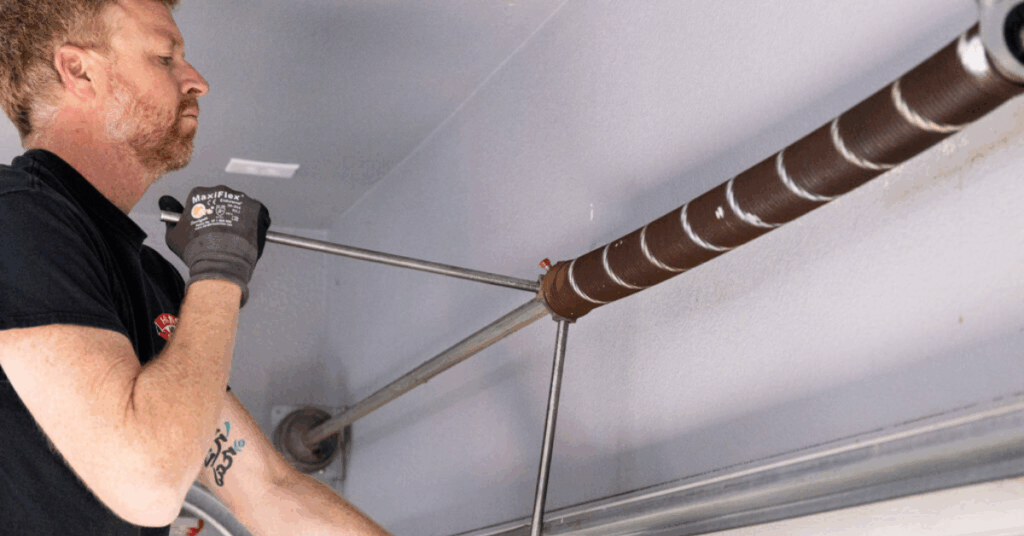
Garage door springs don’t age by the calendar — they age by the cycle, one cycle being one full open-and-close. The standard torsion spring is rated around 10,000 cycles, and the arithmetic writes each household’s timeline: a door used twice a day burns roughly 730 cycles a year and reaches spring end-of-life in 13–14 years; a busy family using the garage as the front door — four, six, eight cycles a day between school runs, work, sports at the Columbia Gymnastics or fields around Centennial — can consume the same spring in four to seven years. This is why the “how long do springs last?” answer ranges so widely and why your neighbor’s timeline tells you little about yours. It’s also why higher-cycle springs exist: paying more for a 20,000-plus-cycle spring roughly doubles the timeline, an upgrade that makes clear sense in high-use households and is worth asking about at replacement time.
What Maryland does to the math
Columbia’s climate shaves the ratings. Winter is the spring-killer: steel becomes more brittle in cold, and the freeze-thaw swings of a Maryland January–February stress metal that’s already fatigued — which is why spring failures cluster on cold mornings, often on the first lift of the day. Humidity is the slow tax: our muggy summers drive corrosion on springs and cables, and rust pits become the stress points where fatigued steel lets go early. A spring living in a damp, unconditioned Maryland garage genuinely runs shorter than its rating suggests. The practical counters are modest and real: keeping springs lightly lubricated (a professional task during tune-ups) slows the corrosion, and a door kept balanced spreads the load the springs were engineered for.
Openers: the 10–15 year appliance
Openers age more like ordinary appliances — 10 to 15 years is the honest range — but their lifespan is hostage to the door they serve. An opener guiding a balanced, well-maintained door coasts to the high end; an opener straining against weak springs or a binding track works far beyond its design load and dies young, often taking its drive gear or motor with it. Maryland adds its notes here too: temperature swings are hard on aging circuit boards, and summer humidity works on wiring and contacts in unconditioned garages. The single best thing a Columbia homeowner can do for opener lifespan has nothing to do with the opener: keep the door itself healthy, so the motor only ever does the light guiding it was built for.
The rest of the system, briefly
The supporting cast has its own clocks. Cables live under the same tension and corrosion pressures as springs and generally warrant replacement alongside them or at the first sign of fraying — checking cables and springs for wear is a core item in every tune-up from Neighborhood Garage Door Repair Of Columbia for exactly this reason. Rollers wear by cycles like springs; worn rollers are the usual culprit behind a door that’s gotten loud. Weather seals take Maryland winters personally and typically want replacing every few years. None of these are expensive individually — the pattern to avoid is letting a cheap worn part (a roller, a fraying cable) load the expensive parts (springs, opener) beyond their design.
Reading the end-of-life signals
Components telegraph their retirement. Springs: the door feels heavier on manual lift, the opener strains or hesitates on the way up, the coils show gaps in the wound spring or visible rust pitting — and the definitive one, the bang from the garage. Openers: intermittent response, straining sounds, a habit of reversing without cause, repeated small failures. Cables: visible fraying or slack. The signals matter because they convert emergencies into appointments: a spring replaced at end-of-life on your schedule is the same repair as the one done same-day with your car trapped — minus the ambush. That’s the entire case for the annual professional tune-up from Neighborhood Garage Door Repair Of Columbia: trained eyes reading these clocks once a year, under a company with 12+ years working Maryland doors and a 1–3 year warranty behind its parts.
The planning takeaway
Put the clocks together and every Columbia garage door has a rough schedule: springs on a cycle-count you can estimate from your household’s usage, openers on a 10–15 year arc, cables and rollers riding along, all of it running slightly hot because Maryland’s winters and humidity say so. You can’t stop the clocks — but knowing them means budgeting for the spring replacement before it happens, replacing the geriatric opener on a chosen weekend rather than a stranded morning, and letting an annual inspection catch what’s next. The door that “suddenly” fails almost never did; somebody just wasn’t reading the clocks.
A homeowner’s clock-reading habit
You don’t need a technician’s eye to track the basics between annual inspections. Twice a year, run three checks. Listen: a door that’s gotten louder — grinding, popping, squealing — is announcing worn rollers or dry hardware. Watch: does the door move smoothly and evenly, or hesitate, jerk, or sit crooked? Feel (safely): with the door closed and the opener release engaged per your manual, a healthy door lifts manually with modest effort and stays put at waist height — a door that feels like dead weight or won’t hold position has a balance problem, which means the springs are due for professional attention. Note what you find, and bring the notes to the annual tune-up. Ten minutes of attention a year, and the clocks in your garage stop being able to surprise you. The households that never have garage door emergencies aren’t lucky — they’re just the ones doing this.
FAQ
How long do garage door springs last? Standard torsion springs are rated ~10,000 cycles — about 13–14 years at two uses a day, but as little as 4–7 years for high-use households. Maryland’s cold snaps and humidity shorten the real-world number; higher-cycle springs roughly double it.
Why do garage door springs break in winter? Cold makes fatigued steel more brittle, and freeze-thaw swings stress the metal — so Maryland springs disproportionately fail on cold mornings, often on the first lift of the day. Corrosion from humid summers sets up the weak points winter exploits.
How long should a garage door opener last? About 10–15 years, with the door’s condition as the biggest variable: an opener straining against weak springs or an unbalanced door dies years early. Keeping the door balanced and maintained is the best opener-lifespan investment there is.
Published July 2026 · Neighborhood Garage Door Repair Of Columbia · 6700 Alexander Bell Dr Unit 235, Columbia, MD 21046