
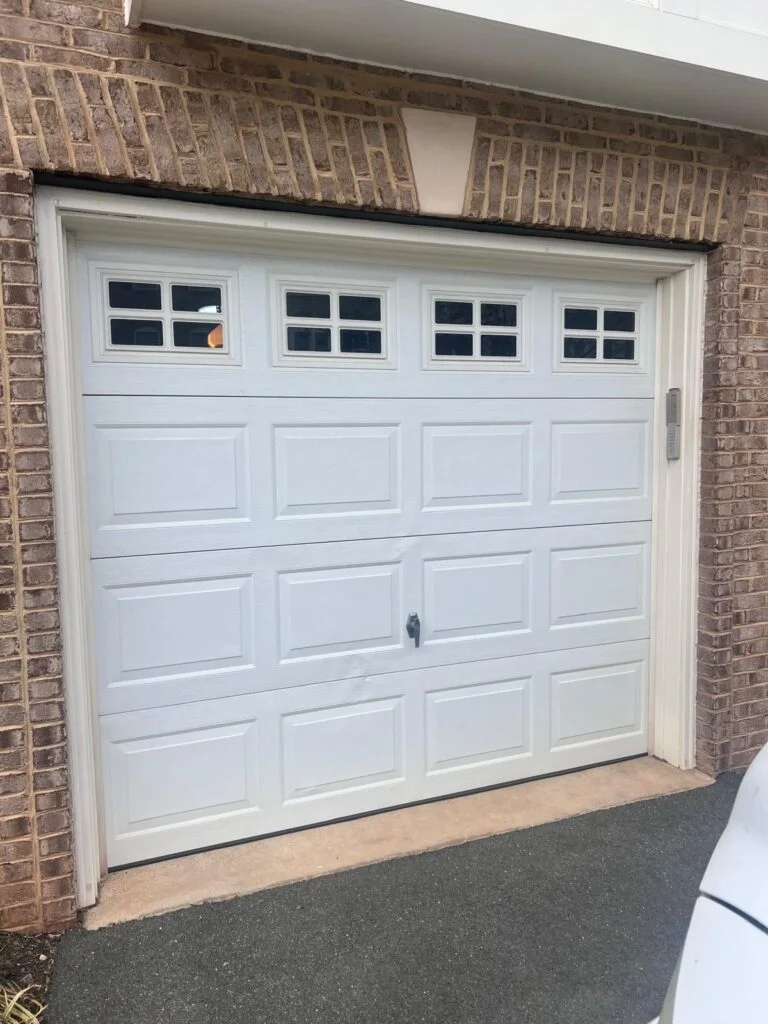
It’s among the most common garage door emergencies and the most embarrassing — which is a shame, because it happens to careful people constantly: the door wasn’t fully up, the morning was rushed, the pedal was pressed a half-second early, and now there’s a bumper-shaped crease in the door (or a door-shaped scuff on the bumper). Take a breath: this is routine for repair professionals, the damage is usually more fixable than it first looks, and the next twenty minutes matter more than the impact did. Here’s the Laurel homeowner’s guide to what just happened, what to do, and how the repair actually plays out.
The first twenty minutes: don’t compound it
The instinct after hitting the door is to cycle it — “let’s see if it still works.” Resist that. An impacted door may have bent panels, shifted tracks, or stressed hardware, and running the opener can turn a one-panel problem into an off-track door or worse. Instead: move the car clear (if it’s not entangled with the door — if it is, leave everything and call). Look, don’t operate: photograph the damage from inside and out — useful for the repair visit and any insurance conversation — and scan for the secondary signs: panels visibly creased or cracked, tracks bent or pushed out of line, rollers out of their channel, cables slack or off their drums, the door sitting crooked. If anything looks shifted, hanging, or off-track, stop entirely — that’s now a don’t-touch-it urgent call, per every rule that governs off-track doors. If the door looks superficially dented but true and even, still skip the test cycle and get it inspected before regular use; hidden track and hardware stress is exactly what inspections exist to find.
What actually gets damaged (it’s not just the dent)
Vehicle impacts injure doors in layers. The panel takes the visible hit — a crease, a crack, a caved section — but panels are also structural: a creased section loses rigidity, which loads its hinges and neighbors every cycle afterward. The tracks absorb the shove: even a modest impact can push a track out of plumb or crimp it, and the door then binds or wears at that spot forever after. Rollers and hinges at the impact zone get stressed or bent. And the opener and balance system feel any impact that moved the door in its opening — force settings, travel limits, and cable seating all deserve a check after a hit. This layering is why the drive-by quote (“just a panel, easy”) is worthless and why a proper post-impact inspection walks the whole system.
Panel repair vs. panel replacement vs. new door
Here’s the decision tree the visit produces. Minor cosmetic dents on steel doors can sometimes be addressed, but honest advice often leaves purely cosmetic dings alone. A damaged section on a current-model door is the sweet spot: individual panel replacement is routine, restores structure and appearance, and costs a fraction of a new door. The complication is panel availability — sections must match the door’s model, size, color, and profile, and for older or discontinued doors, matching panels range from special-order to nonexistent; a close-but-wrong panel telegraphs itself from the street forever. Multi-panel damage, structural frame damage, or an older door with unavailable panels tips the math toward full replacement — often the better spend anyway on a door that was aging, since the new door arrives with new springs, hardware, insulation, and warranty. A trustworthy company walks you through exactly which branch you’re on and why, with the parts-availability reality laid out plainly.
The insurance question, handled honestly
Vehicle-meets-garage-door sits at an insurance intersection, and the general lay of the land (your agent has the specifics for your policies): damage to the door from your own car is typically a homeowner’s-policy conversation, damage to the car is an auto conversation, and deductibles decide whether a claim makes sense at all — many single-panel repairs land near typical deductibles, which is why documentation (those photos) plus a written repair estimate is the right first step before deciding. A detailed, itemized estimate from a licensed contractor — Neighborhood Garage Door Repair Of Laurel provides free written estimates under MHIC #161435 — is exactly the document that conversation needs, whichever way it goes.
Preventing the sequel (and the one that’s worse)
The bumper-tap has cheap prevention: a full-open habit (wait for the door to finish before moving — the seconds feel longer than they are), a visual check in the mirror as part of the backing ritual, and for repeat-risk households, a parking laser or simple floor mark for the pull-in side. The scarier cousin — driving into a closing door, or a door coming down on a vehicle — is what well-maintained safety systems prevent: sensors aligned and tested, auto-reverse verified (the monthly broomstick-in-the-path test takes ten seconds). And after any impact, however minor it seemed, the inspection habit is the real prevention — the doors that fail dramatically months after a “small bump” are the ones where the bent track and stressed hinge were never found.
Choosing who fixes it
Impact repairs are exactly the moment to be choosy, because they mix urgency (the door may not close — a security problem tonight) with judgment calls (repair vs. replace, panel matching, insurance documentation). The checklist is short: a licensed contractor (MHIC #161435 is verifiable in Maryland’s public registry), a written itemized estimate before work, straight answers on panel availability for your specific door model rather than an instant push to full replacement, and the whole-system inspection — anyone who quotes the dent without checking the tracks, rollers, cables, and opener travel is quoting the visible third of the problem. The company that documents everything clearly is also, not coincidentally, the one whose paperwork makes the insurance conversation easy. Embarrassing morning, straightforward fix — handled by the right people, this is a story you’ll be telling as a joke by the weekend.
FAQ
I hit my garage door with my car — can it be repaired? Usually, yes. Single-section damage on a current-model door is a routine panel replacement; tracks and hardware stressed in the impact are repaired alongside. Full replacement enters the picture with multi-panel damage, structural issues, or older doors whose matching panels are no longer available. Skip test-cycling the door and get a professional inspection first.
Should I use my garage door after backing into it? No — don’t cycle it until it’s inspected. Impacts bend tracks and stress hardware in ways that aren’t visible, and running the opener can convert a panel problem into an off-track door. If anything looks crooked, shifted, or off its tracks, treat it as urgent and don’t touch it.
Does homeowner’s insurance cover garage door damage from my own car? Often it’s a homeowner’s-policy question (with the car’s damage under auto), but deductibles decide whether claiming makes sense — many single-panel repairs land near deductible territory. Photograph everything and get a written, itemized repair estimate first; that’s the document every version of the conversation needs.
Where to next: creased door, held breath? Get the full post-impact inspection and written estimate from Neighborhood Garage Door Repair Of Laurel — free, MHIC #161435.
Published July 2026 · Neighborhood Garage Door Repair Of Laurel · 12912 Rustic Rock Ln, Beltsville, MD 20705 · Serving Laurel & the Route 1 corridor