
Broken Garage Door Spring: Why It’s an Emergency (and Never a DIY Job)
The garage door spring is the single most common emergency we see — and the single most dangerous repair to attempt yourself. If you heard a loud bang from the garage and now the door won’t lift, or feels impossibly heavy, a spring has almost certainly broken. This guide explains what’s actually happening, why it can’t wait long, the warning signs that come before a break, and why this is the one repair to always hand to a professional.
What the spring actually does
Your garage door is heavy — often well over a hundred pounds, and considerably more for a two-car or insulated door. The spring system stores energy and counterbalances that weight, so the opener — or your arm — only has to manage a fraction of it. When the spring breaks, that counterbalance vanishes. Suddenly the opener is trying to lift the full dead weight it was never designed to handle, and the door either won’t move or moves dangerously.
Torsion vs. extension springs
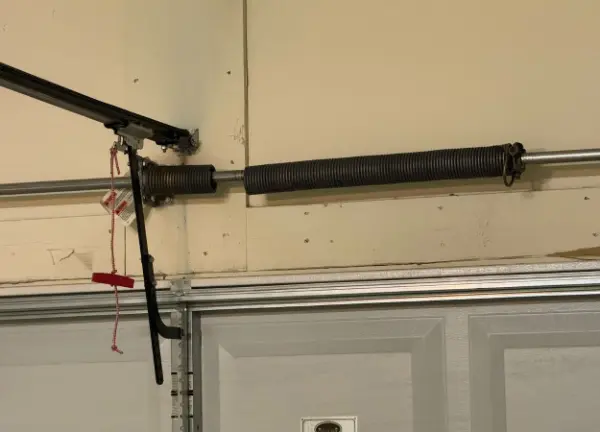
There are two main types, and knowing which you have helps you understand the failure. Torsion springs mount horizontally on a bar above the door and are the more common, more durable modern setup; when one breaks you’ll often see a visible gap in the coil. Extension springs run along the horizontal tracks on either side and stretch as the door closes; they’re older and, without a safety cable through them, can become a projectile when they snap. Either way, the fix is professional — but the type affects the parts and the approach.
Why springs break
Springs are rated in cycles — one open-and-close is one cycle. A standard spring is built for a set number (often in the 10,000-cycle range), and every use spends one. On Kensington’s older homes, many springs are decades past that budget, so failure isn’t a question of if but when. Two things accelerate it:
- Age and cycle count. High-traffic households — where the garage is the main entrance — burn through cycles far faster than a garage used once a day.
- Cold. The DC-area’s winter cold snaps are notorious for spring failures. Steel becomes more brittle as it contracts, and a worn spring that would have lasted another month lets go on the coldest morning of the year. It’s why spring calls spike in January and February.
- Rust and lack of maintenance. Dry, corroded coils wear faster; light periodic lubrication extends life, though it can’t reverse cycle fatigue.
Warning signs before a spring breaks
A spring rarely gives much notice, but there are tells worth heeding: the door feels heavier than usual or hesitates on the way up, it opens unevenly or jerks, you hear a squeaking or grinding from the spring, or you can see rust and small gaps forming in the coil. If you catch these early, a planned replacement is far less disruptive than a sudden failure that traps your car.
Why it’s an emergency
A broken spring isn’t just inconvenient. The door may be stuck down, trapping your car inside when you need to leave. If it’s stuck up, your garage — and often an interior door to the house — is left open. And a door with a failed spring is unpredictable: the remaining hardware is now under loads it wasn’t meant to carry. That combination of security risk and safety risk is why spring failures are same-day calls. Based on company records, roughly 90% of emergency calls are reached the same day, and a Rockville base keeps Kensington inside that window.
Why you must never DIY a spring
This is the firmest rule in the trade. Torsion springs are wound under extreme tension — enough stored energy to cause serious injury or worse if a spring or winding bar slips. The tools, the technique, and the experience to control that tension safely are exactly what a professional brings. Every year, people are seriously hurt attempting spring replacements with the wrong tools or improvised bars. The money you’d save is not worth the risk. If you take one thing from this article: a broken spring is never a DIY job.
What replacement involves
A technician confirms the door’s weight and travel, selects the correctly rated spring — using the wrong size is a common cause of premature re-failure — releases and replaces the spring under controlled tension, rebalances the door, lubricates the system, and tests the safety reverse. Many pros recommend replacing springs in pairs on a two-spring door: if one has reached the end of its cycle life, the other is close behind, and doing both saves a second emergency call weeks later. You get an exact quote before the work starts, and the repair is backed by a warranty (see the site for terms).
How to reduce the odds of a surprise failure
You can’t stop a spring from eventually reaching the end of its cycle life, but you can avoid being caught off guard. A few habits help. Twice a year, watch and listen as the door operates — hesitation, uneven movement, or new grinding noises are early warnings. Light lubrication of the springs, rollers, and hinges with a garage-door-rated lubricant (not general-purpose grease) reduces friction and slows wear; it won’t reverse fatigue, but it buys time. Test the balance occasionally using the manual-release method: disconnect the opener and lift the door halfway — if it won’t hold, the spring is tiring. And if your springs are original to an older Kensington home and you’ve never had them replaced, it’s worth a proactive inspection rather than waiting for the bang. A planned replacement on your schedule is always cheaper and less stressful than an emergency one on the coldest morning of winter, with the car trapped inside.
FAQ
How do I know if my spring is broken or it’s something else? The tells: a loud bang when it happened, a door that’s suddenly very heavy or won’t lift, or a visible gap in the torsion spring above the door. If the door lifts easily by hand and holds, it’s probably not the spring.
Can I still use the door with a broken spring? No. Don’t force it and don’t rely on the opener — lifting the full unbalanced weight can damage the opener and is unsafe. Leave it and call for service.
Should I replace one spring or both? On a two-spring door, replacing both is usually the better value. If one has reached its cycle limit, the second is typically not far behind, and replacing both avoids a repeat emergency and re-balances the door properly.
How long do garage door springs last? It depends on cycles, not just years. A spring rated for a typical cycle count may last many years in a low-use garage or only a few in a busy household. Cold weather and rust shorten that further.
How fast can someone come out in Kensington? Spring failures are treated as same-day emergencies where availability allows — about 90% of calls, based on company records — helped by the company being based minutes away in Rockville.
Where to next: see how fast we reach Kensington emergencies or our garage door repair service.
Published July 2026 · Neighborhood Garage Door Of Rockville · Serving Kensington & southeast Montgomery County, MD