
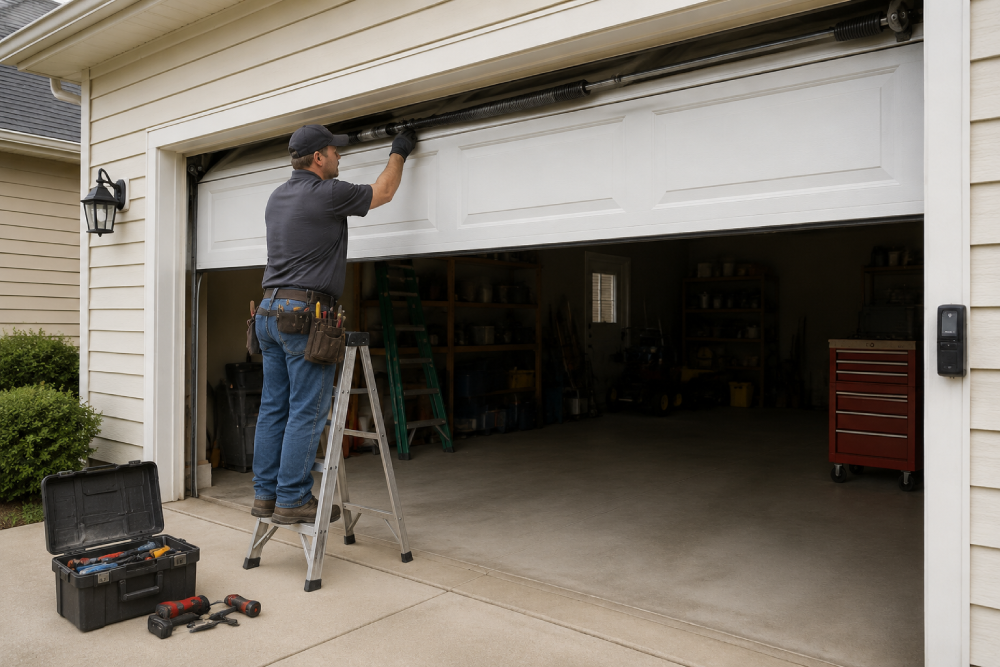
“How much does garage door repair cost?” is really seven questions wearing one trench coat — because a garage door isn’t one thing, it’s a system of components, and each one fails in its own way with its own price logic. The fastest way for a Laurel homeowner to understand any repair quote is to know the menu: what each component does, how it announces its failure, and what drives that specific repair’s cost. Here’s the full menu, decoded.
Springs: the counterbalance (and the headline repair)
The springs do the heavy lifting — literally counterbalancing a door that weighs well over a hundred pounds so the opener only has to guide it. They’re the most common major repair because they’re rated in cycles (a standard torsion spring runs about 10,000 open-close cycles) and every household is quietly spending that budget daily. What drives the cost: spring type (torsion vs. extension), replacing one or the pair (when one of a pair breaks, its same-age twin is usually close behind — the pair is the standard recommendation), the door’s weight and size, and the cycle rating you choose going forward. What never varies: spring work is dangerous, high-tension, and strictly professional — the one item on this menu with a hard no-DIY line.
Cables: the springs’ partners
Lifting cables transfer the springs’ force to the door, live under the same tension, and fail by fraying and snapping — usually announced by a crooked door or a cable hanging slack. Cost drivers are straightforward: cables are replaced in pairs, the job shares the spring system’s tension (and its professional-only status), and cable failures frequently ride along with spring work since both age together. A frayed cable caught at inspection is a modest scheduled repair; a snapped one is a door hanging unevenly and an urgent call.
Tracks and rollers: the pathway
The tracks guide the door; the rollers ride them. Rollers wear by cycle like springs and announce themselves with noise and rough travel — replacement is one of the most economical items on the menu and transforms how a door sounds and feels. Track problems range wider: minor misalignment is an adjustment; a bent track section (usually from impact) means straightening or replacing sections; and a door that’s jumped the tracks entirely is its own serious category. Cost follows the damage: adjustment at the light end, section replacement in the middle, off-track recovery at the heavy end.
Panels: the door’s face
Panel damage — dents, cracks, rot on wood doors, the classic bumper-shaped crease — is the most visible failure and the most variable repair. The drivers: how many sections are damaged, whether the damage is cosmetic or structural (a creased panel can compromise the door’s rigidity), and critically, panel availability — matching a panel to an older or discontinued door model is sometimes easy, sometimes impossible, and that fact alone decides repair-versus-replace on many doors. Single-panel replacement on a current model is routine; multi-panel damage on a discontinued door usually points to a new door.
The opener: the brain and muscle
Opener repairs run from accessories (remotes, keypads, wall consoles — the cheap end) through sensors and wiring, to drive components (gears, belts, chains), to boards and motors. Cost drivers: the failed component, the unit’s age (parts for geriatric openers get scarce), and whether the honest answer is repair or replacement — generally a function of age and failure history. One critical nuance: many “opener failures” are actually door failures — an opener straining against weak springs or a binding track presents as a dying motor. A real diagnosis tests the door’s balance before condemning the opener.
Sensors, seals, and the small stuff
The menu’s bottom section: safety-sensor realignment and replacement, weather seals (Maryland winters eat them), hinges, brackets, and lubrication-and-tune-up service. Individually modest, these items matter because neglecting them loads the expensive components — a dry, misaligned, worn-hardware door makes its springs and opener work beyond their design, and that’s how cheap deferred maintenance becomes expensive repairs. It’s the menu’s quiet lesson.
How the pros turn your symptom into a line item
Bring it together and any Laurel repair visit follows the same path: your symptom (the noise, the crooked hang, the hum-without-motion) points at a component; the technician confirms with an inspection of the whole system — because failures travel in packs on a door where everything shares the load; and the quote arrives itemized, in writing, before work starts. Neighborhood Garage Door Repair Of Laurel runs repairs across the Laurel–Beltsville corridor exactly that way — free estimates, licensed under MHIC #161435, with the diagnosis explained before the wrench comes out. Once you know the menu, every quote reads like arithmetic instead of mystery.
Reading a repair quote against the menu
The menu also arms you against the industry’s bad actors, because garage door repair is a national hotspot for bait-and-switch pricing — the too-cheap phone quote that triples in the driveway. Your defenses map directly to what you now know: a legitimate quote names the component and the repair (not “the door needs work”), itemizes parts and labor per menu item, explains any companion repairs by pointing at the actual worn part, and arrives in writing before work begins. Two questions expose most schemes: “Which specific component failed, and can you show me?” (a real technician walks you to the frayed cable or the gapped spring) and “What happens if we only do the essential item today?” (an honest answer distinguishes must-do from should-do from could-do). A licensed contractor — Maryland’s MHIC registry is public, and #161435 checks out — answers both without friction.
The cheapest item on the menu
One line deserves the closing word: the tune-up. Inspection, lubrication, tightening, balance check — the bottom of the menu by price, and the item that shrinks every other line on it. Springs live longer on a balanced, lubricated door; openers live longer when they’re not straining; rollers, hinges, and cables get caught at “worn” instead of “failed.” Most of the expensive emergencies on this menu spent months as cheap line items first. The households that rarely need this article are simply the ones buying the bottom of the menu once a year.
FAQ
What are the most common garage door repairs? Springs lead (they’re consumed by cycles), followed by cables, rollers, opener components, track adjustments, and panel damage. Each has its own cost logic — springs by type and pair, panels by availability, openers by age and failed component — which is why quotes are itemized by repair, not one flat number.
Which garage door repairs are DIY-safe? Very few: remote batteries, sensor cleaning and alignment, and lubrication of accessible hardware. Springs, cables, drums, bottom brackets, and track work are high-tension, professional-only territory — the components that injure homeowners every year.
Why does the technician inspect the whole door for one repair? Because components share the load and age together — a snapped spring often travels with worn cables, and an opener strains against any unbalanced door. Catching the companion failures in one visit is cheaper than a second emergency call.
Published July 2026 · Neighborhood Garage Door Repair Of Laurel · 12912 Rustic Rock Ln, Beltsville, MD 20705 · Serving Laurel & the Route 1 corridor